The Complete Guide to Grading Basketball Cards: PSA vs BGS Explained

Card grading turns raw collectibles into verified assets. This guide breaks down everything collectors need to know about PSA and BGS — the two dominant grading companies — including costs, turnaround times, grading scales, and which service suits different types of cards. Whether sitting on a 2003 Topps Chrome LeBron James rookie or a stack of 1990s base cards worth submitting, the right grading decision protects investments and maximizes resale value.
What Does Card Grading Actually Do?
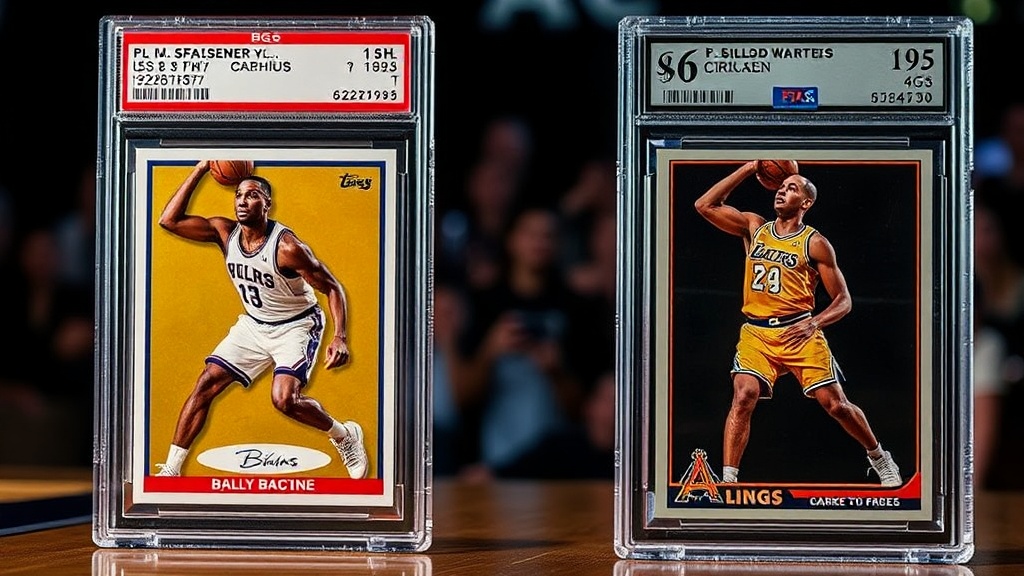
Grading authenticates a card's legitimacy and assigns a numerical condition score. Professional Sports Authenticator (PSA) and Beckett Grading Services (BGS) both evaluate centering, corners, edges, and surface — the four pillars of card condition. After inspection, cards receive a grade from 1 to 10 and get sealed in tamper-evident cases (often called "slabs").
The process isn't just about protection. A PSA 10 Gem Mint Zion Williamson Prizm rookie sells for 5-10x more than its raw counterpart. Grading removes guesswork from transactions. Buyers trust the number in the slab. Sellers command higher prices. That said, not every card warrants the submission fee.
Here's the thing — grading costs money and time. A $20 base card won't justify a $50 grading bill. But a $500 raw card? Absolutely worth the investment.
PSA vs BGS: What's the Real Difference?
PSA dominates market share and resale premiums for vintage and modern basketball cards, while BGS offers more granular subgrades and appeals to collectors seeking maximum condition transparency.
PSA uses a straightforward 1-10 scale. A PSA 10 means Gem Mint condition — sharp corners, perfect centering (55/45 or better on front), no surface flaws visible under 10x magnification. BGS uses the same 1-10 range but adds half-points (8.5, 9.5) and four subgrades: Centering, Corners, Edges, Surface. A BGS 9.5 "Gem Mint" requires three 9.5 subgrades and one no lower than 9.
| Feature | PSA | BGS |
|---|---|---|
| Grading Scale | 1-10 (whole numbers) | 1-10 (with half-points) |
| Subgrades | No | Yes — four categories |
| Population Reports | Comprehensive, industry standard | Available, less referenced |
| Case Design | Red label, tamper-evident | Gold label for 9.5+, tamper-evident |
| Market Premium | Higher for most basketball cards | Comparable for high-grade modern |
| Turnaround Time | 2-6 months (economy) | 3-8 months (standard) |
The catch? PSA 10s typically outsell BGS 9.5s — even though BGS 9.5 requires stricter subgrade standards. Market perception matters. Collectors trust the red label. That said, BGS 10 Black Label (all four 10 subgrades) commands massive premiums, often exceeding PSA 10 prices.
How Much Does Grading Cost and Is It Worth It?
PSA economy service runs approximately $25-30 per card for non-members, with bulk discounts available for 20+ card submissions. BGS standard service starts around $35 per card without subgrades, $50 with subgrades. Express and super express tiers cost significantly more — $150-300 per card — but deliver results in weeks rather than months.
Value calculations depend on the card. Consider a 2019-20 Panini Prizm Ja Morant rookie. Raw: $150. PSA 9: $350. PSA 10: $900. The math works. Now consider a 2020-21 Panini Donruss base Luka Dončić — raw $5, PSA 10 maybe $25. Not worth the grading cost.
Worth noting: both companies charge based on declared value. Submit a LeBron James Exquisite Collection rookie worth $10,000 raw, and economy tiers won't apply. High-value cards require higher service levels with insurance coverage. Always check current pricing at PSA's official site and Beckett Grading Services before submitting — prices fluctuate quarterly.
Some collectors use third-party submittors like Cardsworth or local card shops to access bulk rates without hitting 20-card minimums. These services add $5-10 per card but often deliver faster turnaround through established dealer accounts.
Which Cards Should You Submit for Grading?
Focus on cards with genuine profit potential or personal preservation value. Rookie cards of superstars — LeBron James, Michael Jordan, Kobe Bryant, Stephen Curry, Luka Dončić — justify grading costs at almost any service level. Parallel and serial-numbered cards (Prizm Silver, Select Gold, National Treasures) also grade well.
Inspect before submitting. Hold the card at an angle under bright light. Check for:
- Soft corners (the most common flaw)
- Surface scratches or print lines
- Edge chipping on chrome-style cards
- Centering — borders should be roughly equal
Cards with visible wear won't achieve 9s or 10s. A PSA 8 "Near Mint-Mint" still holds value but rarely justifies the grading investment for modern cards. Vintage cards (pre-1980) follow different rules — even PSA 6s and 7s command respect due to scarcity.
Condition sensitivity varies by set. 1986-87 Fleer basketball — the Jordan rookie set — suffers from print dots and centering issues. 2003-04 Topps Chrome LeBron rookies often show surface scratches from factory packing. Knowing a set's typical flaws helps set realistic expectations.
How Do You Prepare Cards for Submission?
Clean cards carefully. Use a soft microfiber cloth for surfaces — never paper towels or tissues (they scratch). Inspect corners with a jeweler's loupe. Sleeve each card in a penny sleeve, then place in a semi-rigid card saver or toploader. Don't use ultra-tight toploaders that bend corners during removal.
Fill out submission forms meticulously. Declared values determine service tier and insurance coverage. Under-declare and risk insufficient protection. Over-declare and pay unnecessary fees. When in doubt, check eBay sold listings for comparable graded examples.
Document everything. Photograph cards before shipping. Use tracked shipping with signature confirmation — cards have disappeared in transit. Both PSA and BGS offer online tracking portals, though update frequency varies during high-volume periods.
Understanding Population Reports and Scarcity
Population reports — "pop reports" — track how many cards have achieved each grade. PSA's pop report dominates the hobby. A card with PSA 10 population under 50 carries scarcity premium. Population over 10,000? Common as dirt, regardless of the grade.
Before buying any graded card, check the population. A PSA 10 might look impressive until realizing 8,000 others exist. Scarcity drives value more than condition alone. The 1996-97 Topps Chrome Kobe Bryant rookie has thousands of PSA 10s. The 1997-98 Metal Universe Precious Metal Gems Kobe? Different story entirely — pop under 100 across all colors.
BGS population data matters less in the broader market but proves valuable for registry sets — collections competing for completeness and quality rankings. Some collectors chase BGS 9.5 sets specifically, valuing the subgrade transparency that PSA lacks.
When Should You Crossover Between Grading Companies?
Crossover grading — cracking a BGS slab and submitting to PSA (or vice versa) — makes sense when market premiums justify the risk and cost. BGS 9.5 cards sometimes crossover to PSA 10. The gamble? Cards can downgrade. A BGS 9.5 with subgrades of 9, 9.5, 9.5, 10 might PSA 9 due to that low centering subgrade.
Most collectors avoid crossovers on modern cards unless the potential gain exceeds $500. Vintage cards play by different rules — PSA dominates pre-1980 basketball, making BGS vintage less liquid even at high grades.
The best crossover candidates? BGS 9.5s with three 10 subgrades and one 9.5 — often called "true gems." These frequently achieve PSA 10. Cards with 9 subgrades rarely upgrade and usually aren't worth the attempt.
What About SGC and Other Grading Companies?
SGC (Sportscard Guaranty Corporation) has gained traction with vintage collectors and budget-conscious submitters. Their black tuxedo slabs look sharp, and turnaround times often beat PSA and BGS. However, SGC basketball premiums trail the big two — sometimes significantly.
CSG (Certified Sports Guaranty), HGA (Hybrid Grading), and newer entrants offer alternatives with faster service and lower costs. These work for personal collections or PC (personal collection) cards where resale isn't immediate priority. For investment-grade basketball cards, PSA and BGS remain the liquidity kings.
Here's the reality — graded cards trade easier. Raw cards require trust. The slab removes doubt. Whether choosing PSA's market dominance or BGS's grading precision, authentication and condition verification add measurable value to any collection worth protecting.